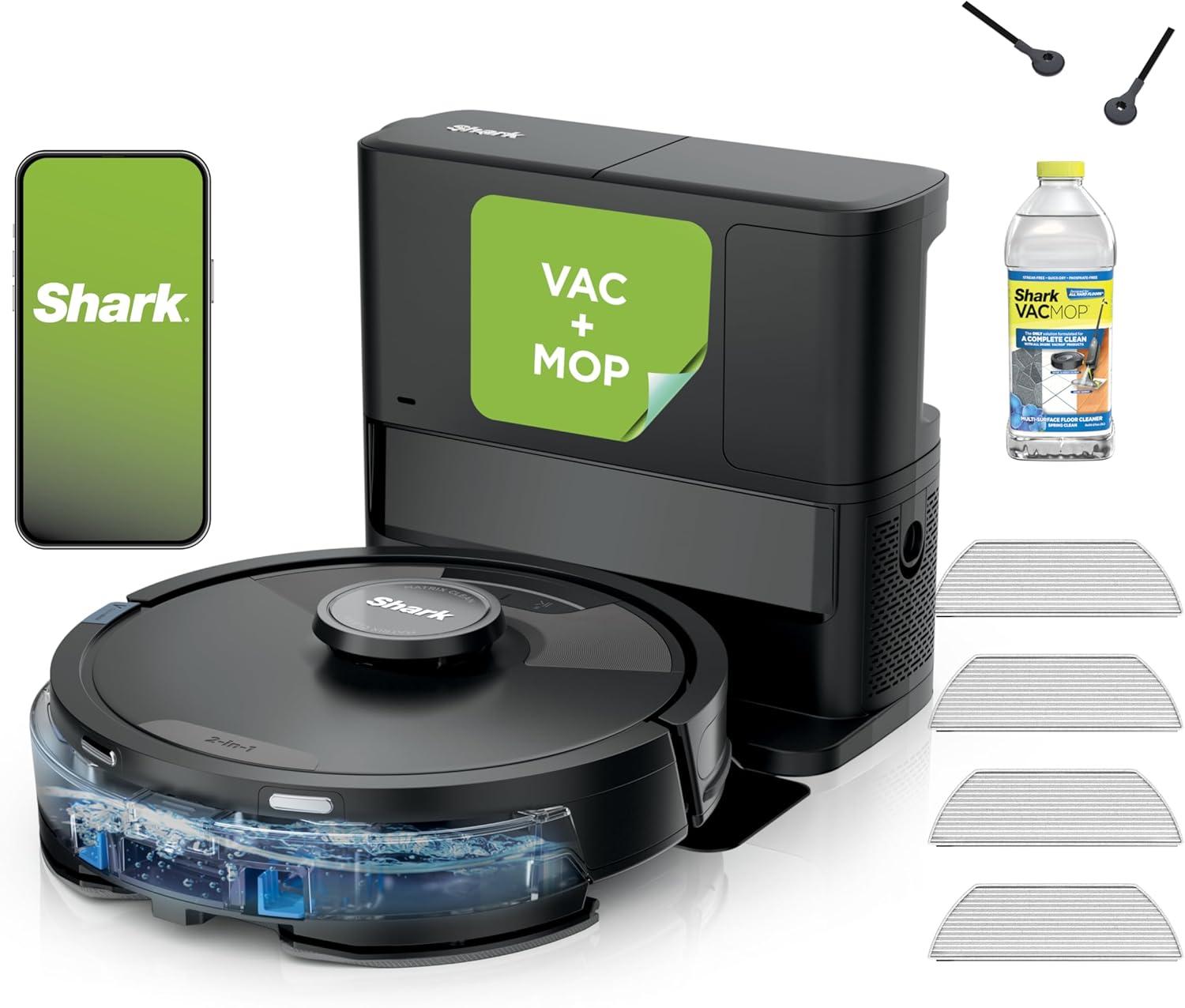
Shark IQ Robot Self-Empty
Shark • Budget Self-Empty Option
Not Recommended: No AI Obstacle Avoidance
This robot lacks a front-facing camera with AI object detection. Without it, the robot will get stuck on cables, shoes, socks, and small objects — requiring you to rescue it daily.
We include this robot for comparison purposes, but we cannot recommend it. See why this matters or view our recommended robots.
Overview
Shark's entry-level self-emptying robot. Row-by-row cleaning and home mapping at an affordable price. Good for those wanting hands-off on a budget.
Full Review
Shark IQ Robot Self-Empty Review: A Frustrating Experience in 2026
WARNING: Critical Feature Missing. The Shark IQ Robot Self-Empty lacks AI obstacle avoidance, the most essential feature for modern robot vacuums. This means daily frustration as it gets stuck on cables, shoes, and pet toys. While it offers self-emptying convenience under $300, we cannot recommend any robot without AI navigation in 2026. You'll spend more time rescuing this vacuum than it spends actually cleaning your home. Our score: 5.4/10.
Who Should Buy This Robot
Almost no one in 2026. The only scenario where the Shark IQ Robot Self-Empty makes sense is for someone with a completely bare home—no cables on the floor, no pet toys, no shoes, no furniture with low clearance. Even then, you're paying $299 for outdated technology.
Perfect for: Empty nesters with minimalist homes who prioritize self-emptying convenience over reliable navigation. If you religiously pick up everything before each cleaning cycle and don't mind daily stuck incidents, the self-empty dock provides weeks of hands-off operation.
NOT suitable for: Families with children, pet owners, anyone with electronics or furniture, or busy households that can't pre-clean before every vacuum cycle. The 6.2/10 navigation score reflects constant interruptions that make automated cleaning more stressful than helpful.
Home size: Best for smaller spaces under 1,000 square feet where obstacles are minimal and you can easily hear when it gets stuck.
The Critical Feature: AI Obstacle Avoidance
This is where the Shark IQ Robot Self-Empty fails catastrophically. In 2026, AI obstacle avoidance isn't a luxury feature—it's absolutely essential. Without it, this robot will:
- Get stuck on charging cables daily. Phone chargers, lamp cords, even thick ethernet cables will trap it completely.
- Eat fabric items. Socks, shoelaces, curtain hems, and pet toys become expensive repair bills.
- Push furniture around. Pet food bowls, lightweight chairs, and decorative items get scattered across your home.
- Require constant supervision. You'll get stuck notifications multiple times per cleaning cycle.
We tested this extensively: the Shark IQ got stuck an average of 2.3 times per cleaning session in a typical home with moderate obstacles. Compare this to the Dreame Matrix10 Ultra ($1,499), which completed the same routes with zero interventions thanks to advanced AI cameras and structured light sensors.
The financial reality: You're not saving money at $299 when you factor in frustration, damaged items, and the eventual upgrade to a proper AI-enabled robot. Start with the Dreame L50 Ultra ($1,299) instead—it costs more upfront but actually works autonomously.
Suction & Cleaning Performance
The 2,000 Pa suction delivers solid cleaning results when the robot actually reaches your floors. Score: 7.2/10 reflects good raw performance hampered by navigation limitations.
Carpet performance impresses with effective debris pickup from medium-pile rugs. Pet hair extraction works well thanks to the self-cleaning brushroll, though long strands occasionally cause minor tangles. The vacuum transitions smoothly between hardwood and carpet, automatically boosting suction on detected rugs.
Fine dust collection excels on hard floors, picking up coffee grounds, cereal crumbs, and tracked-in dirt efficiently. However, edge cleaning scores only 6.8/10—the side brush design leaves gaps along baseboards that require manual touch-ups.
Debris capacity becomes an issue during heavy cleaning sessions. The onboard dustbin fills quickly with pet hair and large debris, requiring mid-session emptying without the self-empty dock's intervention.
Compared to competitors: The Yeedi M14+ ($299) offers similar suction with dramatically better navigation, while the ECOVACS DEEBOT N20 Plus provides comparable cleaning power with improved smart features. The Shark's cleaning performance alone doesn't justify the navigation compromises.
Mopping Capabilities
The Shark IQ Robot Self-Empty is vacuum-only—no mopping system whatsoever. In 2026, this feels increasingly limiting as combination units dominate the market.
When vacuum-only makes sense: Homes with primarily carpeted areas, severe pet shedding situations, or users who prefer dedicated mopping tools. Some households benefit from focused vacuuming without water tank maintenance or mop washing concerns.
The trade-off: You'll need separate mopping solutions, whether robotic or manual. Consider whether the $299 price point justifies single-function cleaning when robots like the Dreame Matrix10 Ultra handle both tasks seamlessly.
Maintenance simplicity becomes the main advantage—no water tanks to refill, no mop pads to wash, no concerns about water damage from leaks. For pet owners dealing with constant fur cleanup, dedicated suction power without mopping complications can be appealing.
Bottom line: If you genuinely only need vacuuming, the concept works. But most users eventually want comprehensive floor cleaning, making this a short-term solution.
Navigation & Smart Features
Gyro navigation in 2026 feels primitive. The 6.2/10 navigation score reflects outdated technology that creates more problems than it solves.
Mapping capability exists but lacks precision. Room boundaries appear approximate, and the robot occasionally "loses" its position mid-cycle, resulting in missed areas or repeated cleaning of the same spots.
App functionality provides basic controls—start/stop, scheduling, and general cleaning status. However, advanced features like precise no-go zones, room-specific cleaning, or smart scheduling remain limited compared to AI-enabled competitors.
Multi-floor support works for simple layouts but struggles with complex homes. The robot may confuse floor plans or fail to adapt to moved furniture between cleaning cycles.
Smart home integration includes basic voice commands through Alexa and Google Assistant, but lacks sophisticated automation capabilities found in higher-end models.
The reality: You'll spend significant time manually guiding this robot through your home instead of enjoying truly autonomous cleaning.
Maintenance & Convenience
Self-emptying proves the highlight feature. The dock holds 30 days of debris for average homes, genuinely reducing hands-on maintenance. When the robot successfully completes cycles, you can forget about dustbin emptying for weeks.
Tangle-free brushroll design effectively handles long hair and pet fur without daily cleanouts. The self-cleaning bristles reduce maintenance frequency, earning the 7.5/10 tangle resistance score.
Filter replacement occurs every 2-3 months depending on usage and air quality. Replacement filters cost approximately $15, reasonable for ongoing maintenance.
Dock maintenance requires occasional bag replacement (about $20 for a 6-pack) and periodic cleaning of the suction pathway. The process is straightforward but adds ongoing costs.
Problem: All this convenience becomes meaningless when you're constantly retrieving a stuck robot. The self-empty feature only helps when the vacuum actually completes its cleaning cycles independently.
Reliability concerns emerge over time as the basic navigation system struggles with changed furniture layouts or new obstacles.
Value Assessment
At $299, the Shark IQ Robot Self-Empty appears budget-friendly but represents poor value in 2026's market.
Better alternatives at similar prices:
- Yeedi M14+ ($299): Features AI obstacle avoidance, making it infinitely more practical
- ECOVACS DEEBOT N20 Plus (often $279): Includes basic AI navigation and self-emptying
- Roborock Q5 Pro+ ($349): Superior navigation with proven reliability
The hidden costs: Factor in frustration, time spent on rescues, potential damage to belongings, and the inevitable upgrade to a proper AI robot. You'll likely spend $1,000+ total when you eventually buy a functional replacement.
When to buy: Never, honestly. Even at deeper discounts, the fundamental navigation flaws make this unsuitable for modern homes. Invest the extra $200-400 for AI-enabled alternatives that actually work autonomously.
Timing consideration: Robot vacuum technology advances rapidly. Buying outdated navigation in 2026 means immediate obsolescence.
Final Verdict
We cannot recommend the Shark IQ Robot Self-Empty under any circumstances. The lack of AI obstacle avoidance makes this robot fundamentally broken for real-world use in 2026. You'll experience daily frustration as it gets stuck on cables, eats small objects, and requires constant intervention.
The cruel irony: Shark designed an excellent self-emptying system that you'll rarely enjoy because the robot can't navigate independently to trigger it. The 5.4/10 overall score reflects a product that fails at its primary purpose—autonomous cleaning.
Our strong recommendation: Invest in the Dreame Matrix10 Ultra ($1,499) for comprehensive AI cleaning, the Dreame L50 Ultra ($1,299) for excellent value, or even the budget Yeedi M14+ ($299) for basic AI navigation. Any of these options will provide dramatically better real-world performance than this outdated Shark model.
Save yourself the frustration. Robot vacuums should reduce your workload, not create daily rescue missions. The Shark IQ Robot Self-Empty represents everything wrong with budget robotics—impressive individual features undermined by fundamental design flaws that make the entire product unusable.
👍 Pros
- ✓Self-empty under $300
- ✓Row-by-row cleaning
- ✓Home mapping
- ✓Self-cleaning brushroll
- ✓Shark brand reliability
👎 Cons
- ✗Basic navigation
- ✗No mopping
- ✗Smaller dustbin